
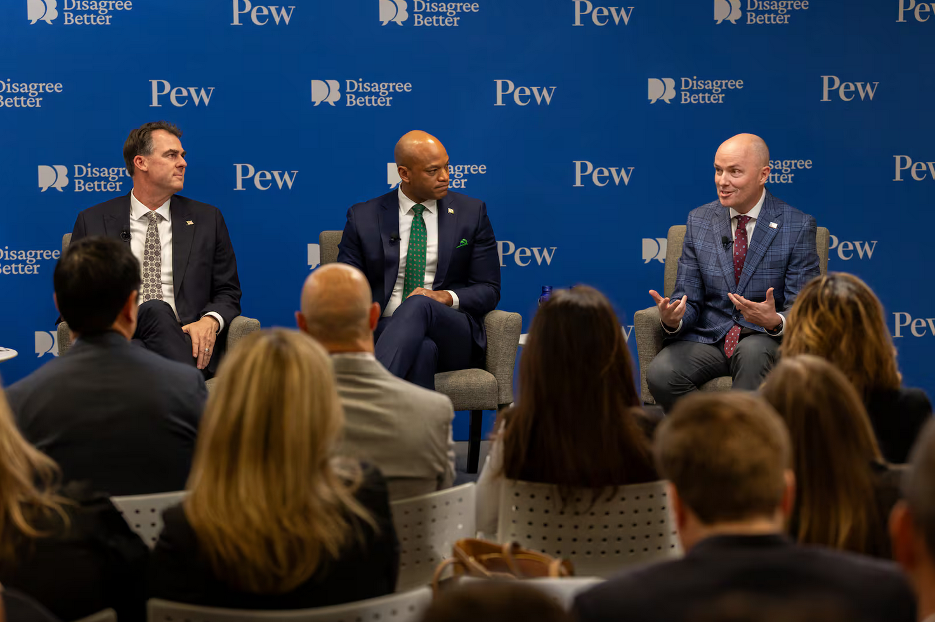
In an event cosponsored by the National Governors Association (NGA) and the Disagree Better foundation, NGA Chair and Oklahoma Governor Kevin Stitt sat down for a roundtable discussion with Governors Wes Moore (Maryland) and Spencer Cox (Utah) on the growing dysfunction of the U.S. federal government-and why they believe governors are uniquely positioned to bring the country forward.
It is a hot topic among voters right now. According to Susan K. Urahn, President and CEO of The Pew Charitable Trusts (which hosted the event), “only 17 percent of the public says that they trust the federal government to do what’s right all the time or most of the time.”
Stitt suggested that public skepticism often stems from the perception that elected officials are motivated to run for personal gain rather than to address their constituents’ needs.
“I think why a lot of people hate politicians is because they think that they see right through them,” Stitt remarked. “They see they’re trying to benefit themselves or they’re trying to benefit their friends or they’re trying to get rich…and we have to elect people of integrity.”
Moore echoed this sentiment, emphasizing the moral foundation he believes effective public leadership requires.
“Public service is not selfish, at least it shouldn’t be,” Moore said. “It’s selfless.”
But the governors also pointed to more systemic issues that fuel voter dissatisfaction, among them, a sentiment that average Americans have limited control over political outcomes. Indeed, Stitt asserted that the legislative process is typically not driven by lawmakers but rather by outside interests.
“The legislators never come up with these bills,” Stitt said. “The industry [that will benefit] comes to [the lawmakers] and hires a lobbyist and says, ‘Here, come write this and go introduce this.’”
He added that this imbalance shapes legislative outcomes long before the public can provide feedback on new policies.
“Money is always on the yes side,” Stitt said. “The taxpayers don’t get together and hire a lobbyist to…vote no.”
America’s Governors: Stability in Chaos?
Moderator Steve Inskeep of NPR opened the discussion by asking the governors about President Trump’s decision to uninvite Governor Moore and Governor Jared Polis (Colorado) from a White House function, calling them “not worthy.” The governors used the moment to highlight how, despite national political tensions, they continue to work together on issues that matter to their respective states.
As governors share insights on mutually important issues, they act as a bulwark of calm and productivity against a tumultuous, dysfunctional federal government. Within policy spheres where they disagree, their involvement in institutions like the NGA enables them to work through differences productively. Moore described the NGA as a rare space where bipartisan cooperation is both still practiced and celebrated.
“In times of chaos, what we’ve seen from the NGA is calm,” Moore said. “In times of confusion, what we’ve seen from the NGA is collaboration.”
Stitt, Moore and Cox emphasized that governors, regardless of party, routinely seek out best practices from other states and apply them to benefit their citizens. Stitt cited an example where the Connecticut governor sought his advice on reducing energy costs, leading the two to find common ground on elements of permitting reform.
Moore summed up the governors’ commitment to fighting for their states’ interests while learning from each other’s successes and failures.
“What makes governors special is that we don’t get into the partisan foodfight,” he said. “[We’re] built different.”
A Shared Vision
The Maryland governor also asserted that rebuilding trust in government begins with rebuilding trust in one another. He argued that Americans have grown increasingly isolated from people with different backgrounds and viewpoints, which he believes threatens the long-term effectiveness of democracy.
“People are just way too comfortable being in their silos,” Moore said, noting that meaningful human interaction is often the first casualty of political polarization.
To counter this backsliding in civic engagement, Moore stated that the key is to promote community service as a valuable learning opportunity.
“I believe that service will save us,” Moore said.
To that end, he discussed his state’s recently implemented Maryland Corps for high school graduates, which is designed to bring together youth from different backgrounds through community engagement.
“We made Maryland the first state in the country to have a service year option for all of our high school graduates,” Moore announced. “I want to get our young people to get to know each other again.”
Maryland’s program is flexible, allowing students to participate in a variety of community service opportunities from academic tutoring to environmental stewardship. Participants earn a living wage of $15.00/hr and receive a stipend upon completion for tuition or other purposes.
“We’re not going to tell you how to serve, we’re just asking you to serve,” Moore said of the initiative. “Just tell us what makes your heart beats a little bit faster.”
Cox echoed Moore’s belief that service can help bridge divides. But rather than urging young people to pursue grand, world-changing missions, he argued that the most meaningful impacts are often made close to home.
“We should stop telling kids that they need to go out and change the world,.” Cox said. “Where we make the biggest difference is in our neighborhoods. It’s getting to know that neighbor, seeing who’s struggling. It’s serving.”
Despite their optimism about the power of service, the governors acknowledged that their ability to drive sweeping change is limited.
“A governor can do anything;, they just can’t do everything,” Moore said, quoting Cox.
The discussion closed on a lighter note as Stiff offered a humorous but pointed metaphor about the current state of national politics.
“Right now, my party’s in the driver’s seat. The Democrats are in the passenger’s seat. We’re in a car speeding towards a cliff, and we’re worried about what’s on the radio.”












Anonymous • Mar 9, 2026 at 11:04 PM
Incredibly and astutely on the mark! Everyone needs to read this.