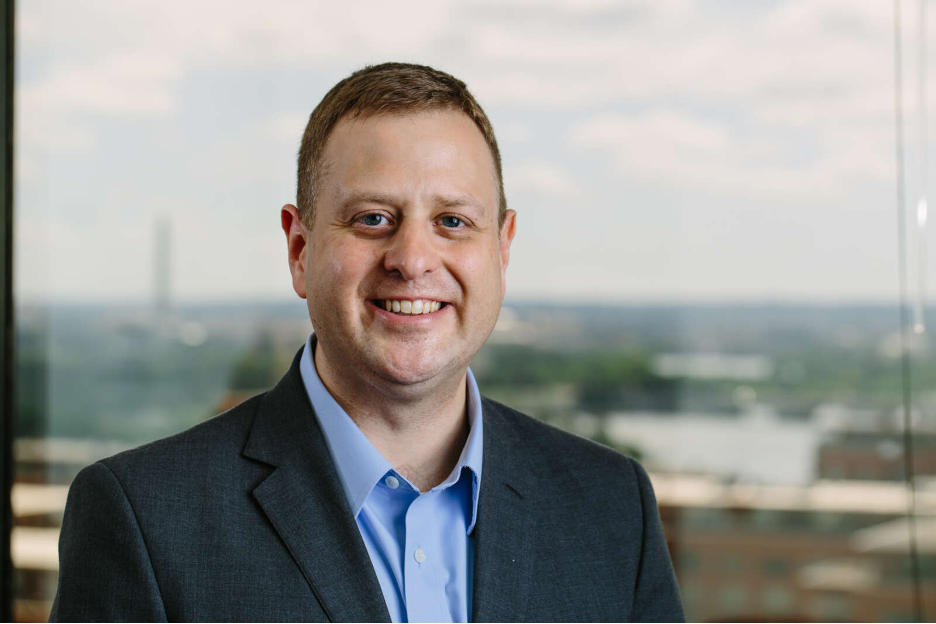
As the Virginia General Assembly session continues into March, Democrats are using their expanded majority in the House of Delegates and sweep of statewide executive offices to push forward an ambitious legislative agenda. Delegate Patrick Hope (D), who represents Arlington’s 1st District in the House, has emerged as a key voice in shaping that agenda.
In December, I spoke with Hope about what his party should take away from its recent electoral gains, as well as to his stance on local government reform in Arlington. He began by describing the strategy behind their successful campaigning.
“I’m on the campaign committee during this election for the House of Delegates. We targeted 14 races that we wanted to flip from red to blue. And we won the 13 of them,” Hope said. “The one that we lost…we only lost by 200 votes. So I think the lesson that’s learned is that, look, Trump’s not on the ballot. And he’s very unpopular. His policies are very unpopular.”
Looking ahead, Hope believes Democrats should continue emphasizing kitchen-table issues, which he says ultimately resonated the most with voters.
“We stayed very focused on our message of affordability,” Hope said. “You can’t lie to people and say that things are cheaper now, that inflation is low.”
Northern Virginia has faced significant economic strain over the past year, due to deep cuts to the federal workforce and the fall 2025 government shutdown. Hope argued that these disruptions affected families across the political spectrum and helped fuel Democratic victories.
“[Those] cuts affect [both] Republican and Democratic families,” he said. “And now, as a result, you don’t have a Republican in the House of Delegates in Northern Virginia–not a single one, going all the way down to Stafford County.”
Although Hope’s seniority (he has served since 2010) gives him considerable influence in shaping legislation, he stressed that staying connected to constituents remains at the core of his work.
“Of course, being in seniority is a tremendous obligation now because I’m in a position of power when I can actually get things done,” Hope said. “But what really makes a good elected official is listening and then taking action.”
When it comes to Arlington local government reform, a topic that has seen increasing community interest in recent years, Hope reiterated his view that the current structure is outdated and no longer meets the needs of a rapidly changing county.
Arlington’s current form of government, known as the county-manager system, was adopted in 1932. It remains the only local jurisdiction in Virginia governed under this structure, in which five at-large board members are elected, with the chairpersonship rotating annually.
“In 1930, [Arlington County] had approximately between 28,000-29,000 residents,” Hope noted. “Today, [Arlington County] has 240,000 people. So if it made sense in 1930 to have five board members, the question is, does it still make sense today?”
Only five people of color have served on the Arlington County Board in its 94-year history. Delegate Hope asserts that eliminating the former district-based system has contributed to the exclusion of African Americans and other racial minorities from the political process.
“You have to remember what life was like for a person of color in 1930,” he said. “We know they couldn’t sit at lunch counters, they couldn’t go to libraries, they couldn’t go to parks, they couldn’t go to movie theaters. And they couldn’t attend the same schools. And I happen to wonder if things [could] have been a little bit different.”
Arlington is also the only locality in the Commonwealth that must obtain the General Assembly’s permission to change its form of government. Hope highlighted how significantly this legal arrangement limits county leaders’ ability to pursue reforms.
“Right now, the locality can’t make this decision,” he said. “If the board wants to expand the number of board members, if they want to elect their chair by the people, or if they want to move from at large to districts or even a hybrid approach, they can’t do it. The General Assembly has to allow them to do it.”
Ultimately, Hope believes that any change in governance should be driven by Arlington voters.
“I think the public should have an opportunity to weigh in on their own self-governance. That’s what representative democracy looks like,” Hope said.