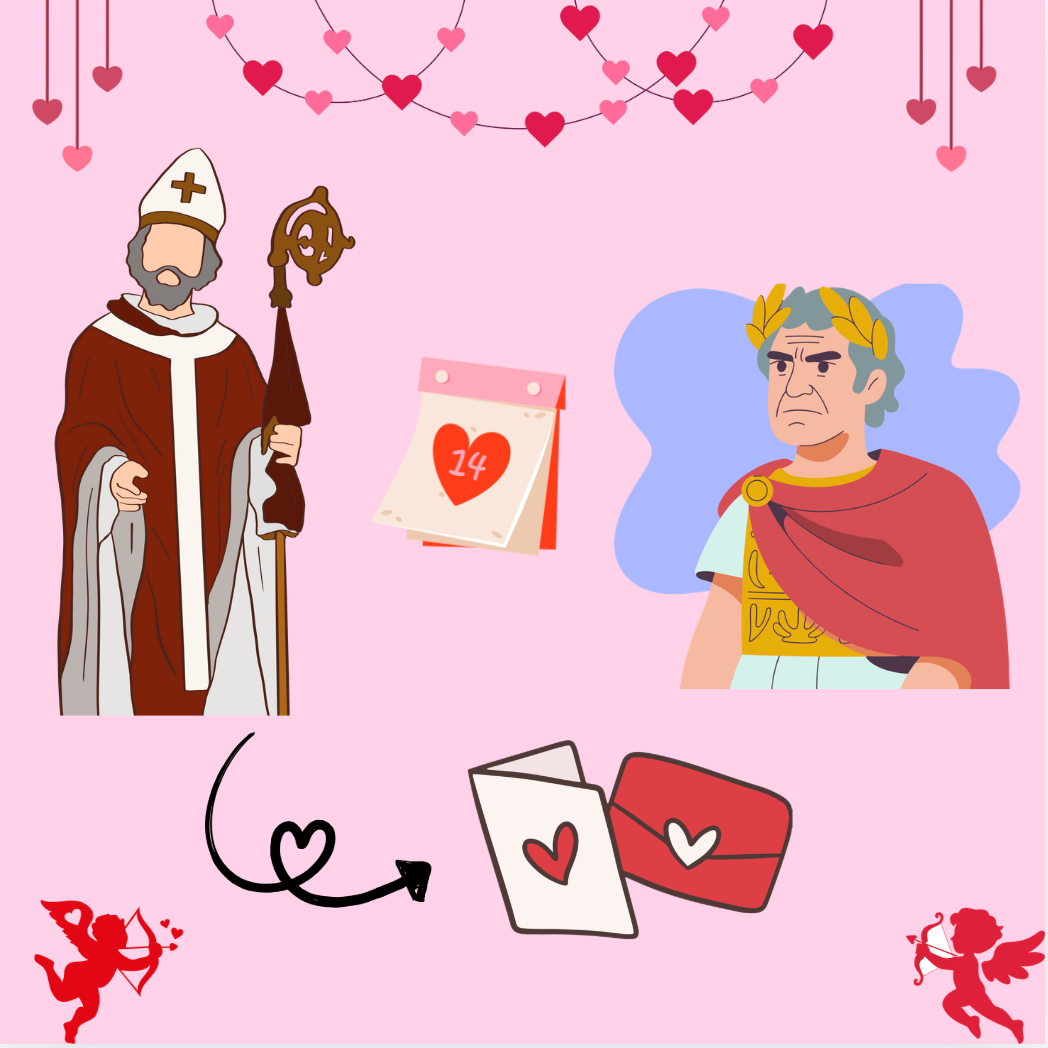
With Valentine’s Day coming to a close, it is important to understand where the holiday of love originated from and how it has evolved over the years. In fact, there is not one confirmed origin of the holiday. Multiple stories and legends have been told about how Valentine’s Day started.
A common belief is that the holiday originated as a day of honor for St. Valentine. However, the Catholic church recognizes three saints named Valentine or Valentinus.
One, St. Valentine was a Roman priest. According to history.com, the Roman emperor Claudius II in 268-270 AD decided to outlaw marriage for younger men because he believed that men were better soldiers without wives and kids. This St. Valentine married people in secret, which eventually led to his execution.
Another legend is that St. Valentine was a bishop of Interamna in Italy who was similarly executed by Emperor Claudius II, for converting new believers to Catholicism and standing by his faith.
One folk tale according to history.com, surrounds a different St. Valentine in the 3rd century who was in jail for marrying couples in secret and was simultaneously in love with a girl (potentially the jailer’s daughter). Prior to his death, he supposedly wrote her a love note, signed “from your Valentine,” a phrase commonly used today. This is said to mark the first written Valentine which is a tradition that has carried on to this day.
There is also the idea that the Christian church may have moved the feast day of St. Valentine to the middle of February to “Christianize” the pagan celebration, Lupercalia. According to history.com, Lupercalia was a fertility festival devoted to the Roman god of agriculture and the Roman founders. At this event, a goat and a dog would traditionally be sacrificed, believing that this would bring fertility and purification. The goat would be skinned and cut into pieces to delicately slap women and crop fields. This was thought to increase fertility in the near future.
Valentine’s Day has gradually evolved into what it is today. In medieval Europe, February 14 was believed to mark the start of the mating season for birds. It later became a celebration of the start of spring. In the mid-18th century, it was customary for friends, family and lovers to send each other small gifts and letters to show their love on this day. With improved printing technology, printed cards became common. .
Valentine’s Day now includes exchanging cards, flowers, chocolate and dinner dates with loved ones. Today, Valentine’s Day is the second largest card sending holiday, the first being Christmas. The popular holiday has many stories and tales of the origin of the holiday, varying from revolting priests to sacrificing goats.