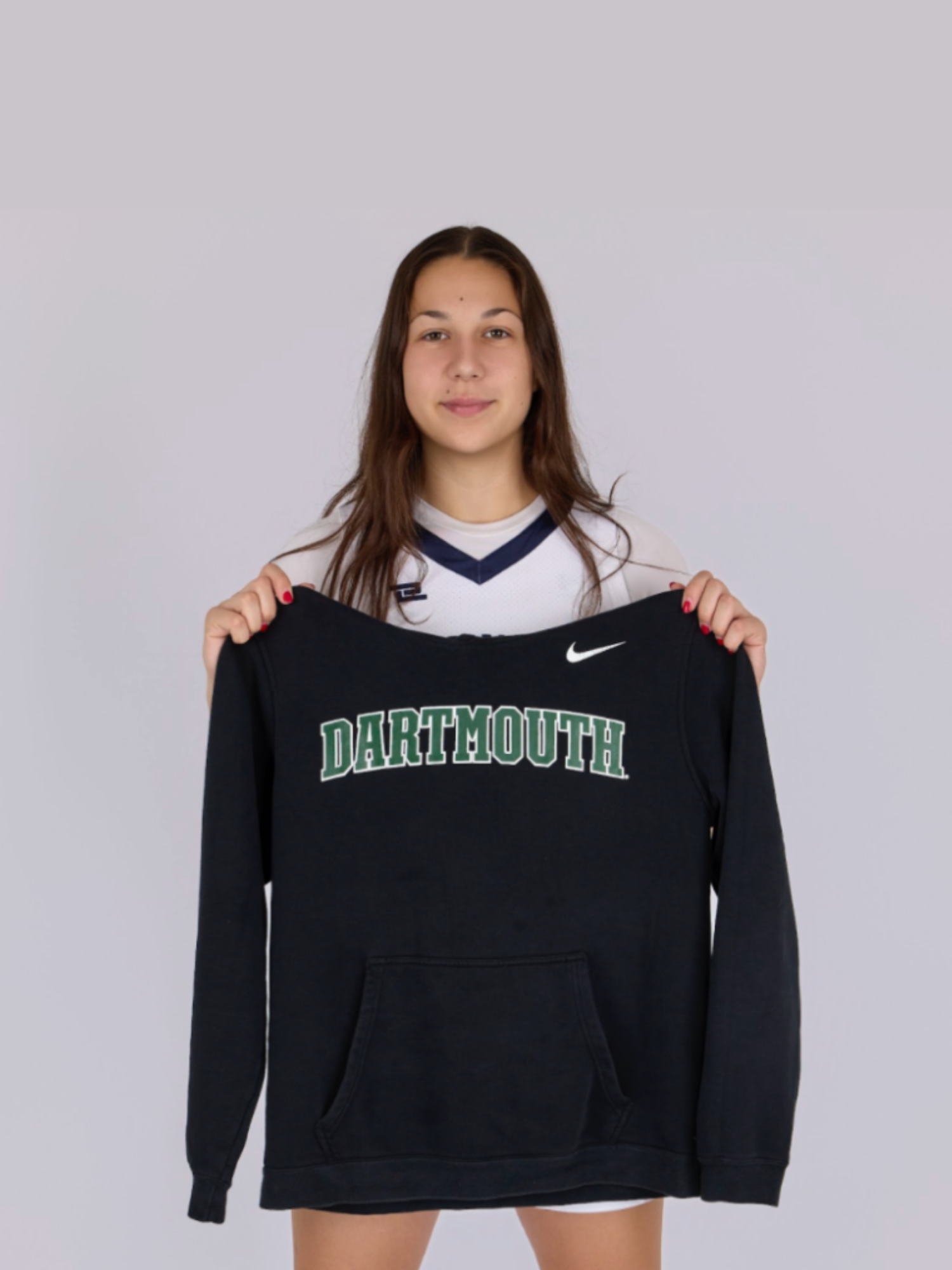
Athletics play an intrinsic role in the school’s community. This year’s graduating class has played a significant role in this sports culture, with more than 15 students planning to play their sports at the collegiate level. One prospective athlete is Eve Jungman, who will be continuing her basketball career at Dartmouth College’s Division I program.
Committing to basketball as a female athlete is extremely challenging; only 1.4% of high school athletes make it to the Division I level. Standing out among more than 350,000 other high school players nationwide is a feat not to be taken lightly.
Jungman’s journey to her commitment has been extensive. She began playing basketball competitively in middle school. The 6’3 forward played varsity for the school all four years, along with varsity volleyball and flag football in the fall and varsity track and field in the spring, winning the state track meet in shot put last spring. She participated in travel basketball during the offseason. She mentioned the reasoning behind her decision to attempt to play in college amidst all her other athletic activities.
“Basketball has had a major impact on my life since I started taking it seriously in seventh grade,” Jungman said. “It’s helped grow my confidence and my sense of purpose a lot, and it’s given me a really strong community, both at school and with club basketball and training and so forth… I think it [just] teaches you so many lessons, and it’s an integral part of my identity at this point, and so I wanted to take it to the next level.”
It was during her freshman year of high school that Jungman first realized Division I programs were a possibility. Although it was not her initial focus, receiving her first recruitment call awakened her to the opportunity of playing basketball in college.
“I got my first D1 call when I was a freshman,” Jungman said. “I think, honestly, when I got the call, I first was [thinking], ‘Oh, this is actually happening,’ and I hadn’t really thought about it that much previously.”
Leveling up in her basketball career encompassed playing on a competitive club team during the high school offseason. Although Jungman said her club team gave a greater advantage in recruitment, she noted that playing in high school provided a better community.
“[Club was] definitely more important for recruitment, especially for me, being at a public high school that didn’t really have anything to do with recruitment,” Jungman said. “I enjoyed high school more because of the way it was set up, and the way we got more support for each game and each practice, and [we were] valued more as individuals, whereas club, it felt a little bit more transactional.”
The community that results from participation in any sport is gratifying. However, Jungman’s relationship with her younger sister, Anna, particularly impacted her feelings about playing for the school.
“Before my junior year, there was a lot of discussion in my house about whether I would transfer to another school and whether my sister would come to [the school] or go to a different school,” Jungman said. “So I think ultimately, when we decided to both go to [the school] and play together for two years, that was my favorite moment from my career.”
The two Jungmans’ relationship proved successful on the court and behind the scenes. Combined, the sisters have over a decade of competitive basketball experience, and these skills earned them recognition from coaches in the district, region and state. Jungman reflected on the benefits of connecting with her sister both in and out of practice.
“It was fun to be able to talk about the season at home and share goals and experiences,” Jungman said. “It was sweet to have her be a part of my senior night and final moments with the program.”
Jungman said that playing for the school had a particularly special impact on her decision to pursue basketball after high school, especially when compared to her experience with her club team.
“In terms of my [high school] teammates, [they] helped me get more excited about playing in college, because I loved having that place every day to see people I love and spend time with a community I loved, especially since you don’t really get that community in the same way in club [basketball],” Jungman said. “I think that definitely if I hadn’t played for W-L in high school, I would not be as excited about playing in college.”
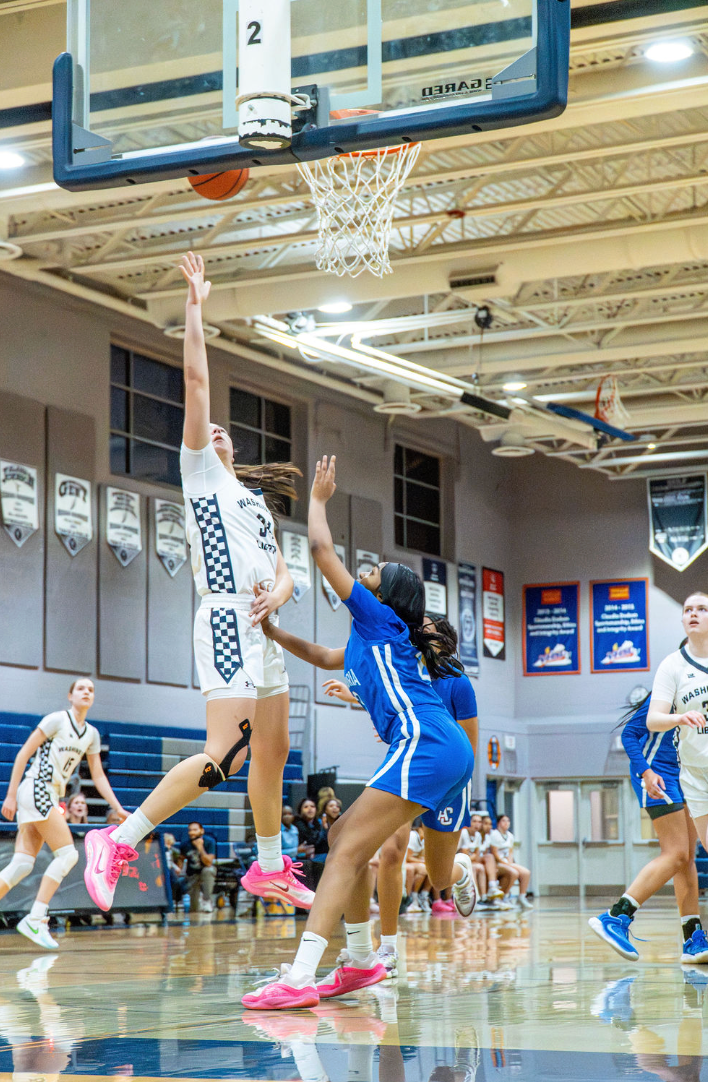
But despite this excitement, there were times when Jungman was overwhelmed by her workload. Trying to manage her schedule of schoolwork, basketball practices and extracurriculars was extremely taxing. On top of that, she had to deal with the added stress of the recruitment process. She commented on what those struggles looked like in her experience.
“[I would describe recruitment in one word as] chaotic,” Jungman said. “There’s so much going on. I was talking to probably 30 schools at once my junior year, and then it would genuinely be [around] three different calls per day… and I already have a busy schedule, [so] that was not fun. And then presenting yourself to each coach, [while] sometimes you present yourself in a little bit of a different way, depending on the school. It’s just really hard to keep track of.”
Jungman was forced to schedule her calls with coaches during her lunches, track practices and while driving to travel practices. This constant time commitment made it challenging to keep up with all her other responsibilities.
“I will say junior year was pretty crazy, and I definitely didn’t have the greatest balance,” Jungman said. “I spent a lot of time at coffee shops, doing work between practices … and I basically did not have much of a social life junior year. So that was a sacrifice I had to make to be able to [commit]. But then ultimately, it’s worth it, because this year, everything has calmed down, and I’m able to balance everything a lot better.”
As a full International Baccalaureate (IB) candidate, Jungman had to prioritize school just as much as basketball, especially when considering Ivy League schools. She mentioned the emphasis placed on her academics during her recruitment.
“Every single coach I talked to asked me for my transcript, even schools that were not particularly high [academically],” Jungman said. “So [academics] definitely [are] a consideration. And I think because I’m a high academic student, it made me an easy recruit… [but] if you’re not fortunate enough [to] be in a position where that wasn’t an issue, then that can definitely complicate the process.”
Aside from Dartmouth, Jungman was considering Columbia University, Cornell University, Brown University and the University of Pennsylvania. The Ivy League schools necessitate even more requirements than other universities.
“Especially once I decided to focus on the Ivy League, [there was] a whole separate academic process,” Jungman said. “I had to do an academic preread before they could offer me. Then I had to do a pre-admit before I could commit. And then I had to do the whole admissions process… [And] as soon as any of the Ivy League coaches started talking to me, they would ask me for my transcripts, test scores, [and] extracurriculars to see if there was any chance I would get in. So I think that has a huge impact.”
Another factor besides academics that played a role in Jungman’s commitment to Dartmouth was her interactions with the coaches and team. There were several factors to consider when deciding whether to go into a D1 program, including the institution’s time commitment requirements and the community.
“I was looking at a few of the Ivies and then also a couple other high academic mid-major [D1] and then some high academic D3s,” Jungman said. “Ultimately… I first decided that I wanted to go [to an] Ivy League because I like the setup of it being D1 still, but more of a focus on academics and [activities] outside of basketball, because it’s such an elite institution. …I chose [Dartmouth] because I liked the coaching staff and I liked the community environment of the school when I visited.”
Apart from the schools she was considering, the coaches and environment her potential teammates brought were especially important in her decision to commit. She explained her thoughts on the reasoning behind this.
“Something a coach told me is that girls have to bond to win, and guys have to win to bond,” Jungman said. “So I think I had several visits where [the coaches] would have me come at the same time as another recruit that they were trying to get to commit …[and] I met the team on a lot of my visits, [because] if you can get girls to connect with their teammates, it makes everything a lot easier, whereas I think guys are more just focused on the straight facts of the school.”
That was not the only inconsistency between Jungman’s experiences as a female athlete and the experiences she observed among the male athletes at the school. Typically, in sports like basketball at the high school level, where boys’ games are more popular, girls’ draw fewer spectators, limiting budget options. This, however, did not deter Jungman from pursuing the sport.
“I will say W-L does a pretty good job of making, or at least trying to make, female athletes feel just as celebrated as male athletes,” Jungman said. “I definitely did notice some discrepancies, mostly with budget, which comes from just greater attendance at male sports. We definitely did [notice] a few things like, ‘Oh, the guys have nicer equipment than us. The guys have nicer gear than us,’ but I never felt like that was a result of being [underappreciated]. It was just that we didn’t have the [same funding].”
Jungman remains optimistic about the recognition she will receive as she plays her sport at a higher level. Recently, there has been a massive increase in interactions with spectators in women’s basketball at the collegiate level. This year, ESPN’s coverage of Women’s College Basketball experienced a 19% increase in views from last season.
“I think… women’s college basketball has gotten so much traction lately, because at that [higher level], everyone is a good athlete and it’s going to be a good game no matter what,” Jungman said. “There’s obviously differences between men’s and women’s, the style of play is just completely different, but I think more people are starting to recognize the value of women’s style of play in basketball, and that’s why women’s [basketball] is gaining a lot of momentum.”
Jungman commented on the steady increase in recognition the girls have been getting over the course of her years at the school, a trend that hopefully continues throughout her collegiate basketball career.
“W-L is very lucky to have a lot of committed athletes,” Jungman said. “I will say I’m the only one for girls’ basketball in a good while. So I do think that helped with [student recognition]. We did not have a good student section, but we had, for the past, I think four years, it’s kind of increased every year the amount of recognition we get from the student body and from the administration, and we’ve done better as a team, so I’m not going to take credit for that. We’ve gotten better every year without getting recognition.”
Last year, worrying about student turnout was far from Jungman’s mind. In the midst of narrowing down her school selection, her junior year priorities focused mainly on what she needed to do to impress specific coaches.
“Last year I was pretty focused on, ‘Oh, I need film of this to send to coaches,’” Jungman said. “I would tell my coach, Coach Maddy, ‘I need to play in this scenario,’ because this is what this certain coach wants to see, [and] I did not have to do this year. So I could just play to what the team needed, what my teammates needed. So that was great.”
Instead of having to manage the pressure of commitment alongside all the other stressors of her senior season, Jungman was able to commit to the Dartmouth admission process at the end of her junior year. She expressed her appreciation for having made the decision out of the way.
“I’m really grateful to have been committed during this season,” Jungman said. “I know some people for other sports were still going through the process this year, and I think that would have been incredibly stressful with the whole college application process on top of senior year on top of [my] last season of sports. I’m just really grateful that I had that figured out [my commitment] by the end of junior year. It allowed me to kind of focus this year on my team, and show up in the ways my team needs me.”
Jungman’s early commitment alleviated the uncertainty most seniors experience in their final year of high school. She offered advice to those looking to commit, noting the contrast between her junior and senior years of school.
“I would say just trust the process,” Jungman said. “It’s crazy for a little while, [but] it’s great now, and I’m really grateful to be committed. Having my plans for next year throughout the whole college application process this year, where all my friends were super stressed out, I was fine… Last year was crazy, but it’s worth it. So just stick it out.”
Jungman’s accomplishments are reflected in her ability to stay consistent throughout the difficult moments of recruiting. This year, she was awarded Most Valuable Player (MVP) by the school’s team coaches. She made the first-team all-district, first-team all-region and second-team all-state. She was also recognized as the Liberty District’s Player of the Year. She looked back on her time at the school, as well as the future opportunities playing at the D1 level.
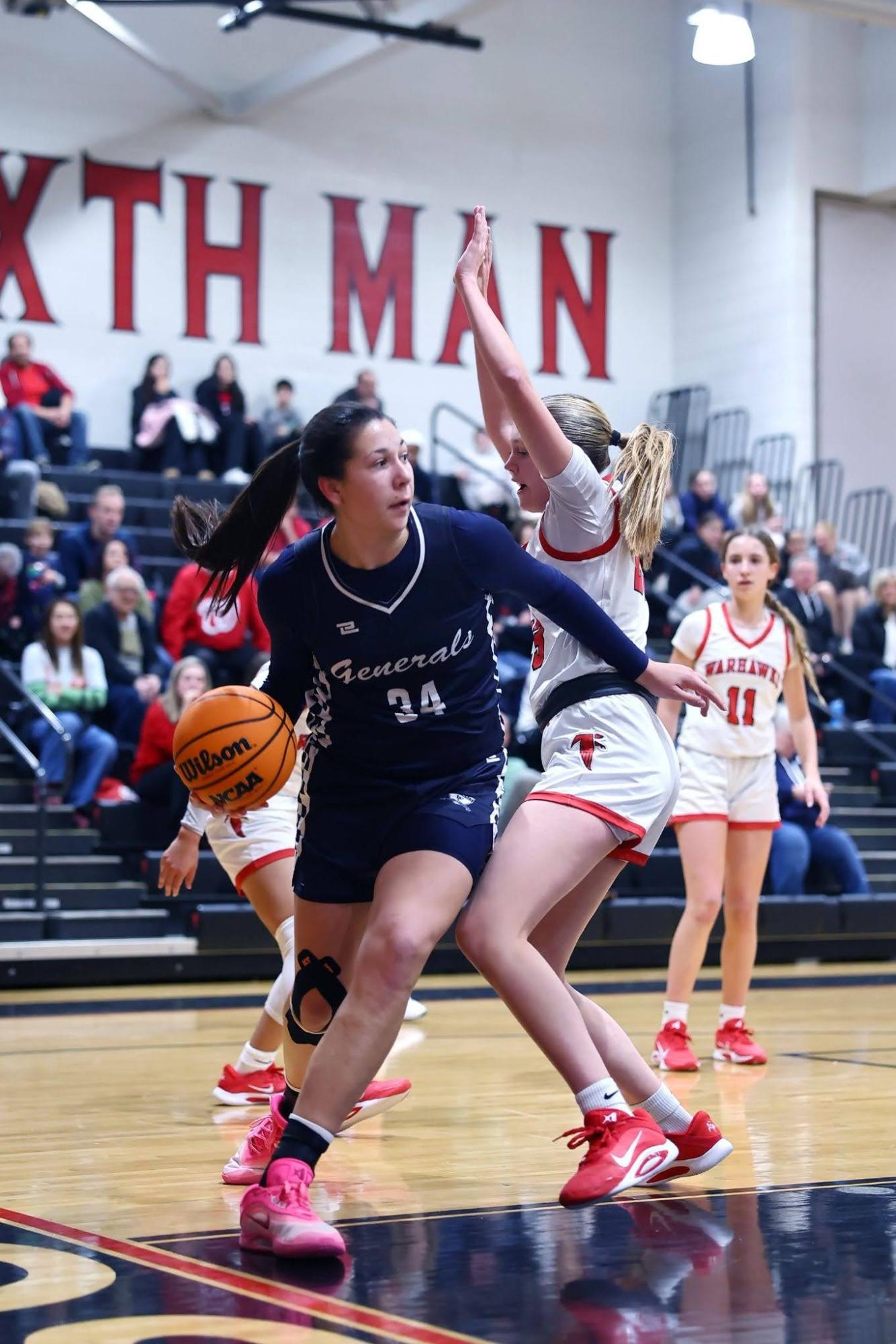
(Victor O’Neil Studios)
“It means a lot,” Jungman said. “Honestly, it hasn’t been my goal for that long, but for my entire high school career, I had that goal in mind, and I just think my younger self would be really excited to see where I’m at today. So I like the idea of making my younger self proud.”