The soundtrack to the 2025-2026 school year is the banging of pouches echoing in the stairwell. After the pilot program at Wakefield High School last year, Yondr pouches have been implemented in five different high schools across Arlington Public Schools (APS). From 8:12 a.m to 3:10 p.m., or from 7:30 a.m. if students have an early period, phones must be locked up in the magnet Yondr pouches and kept away in your backpack all day.
This policy was not an easy task to roll out. Originating from the authorities above, specifically Governor Glenn Youngkin, his executive order states that Virginia students must have phones off and away during instructional time. Implementing this in a high school as large as Washington-Liberty has been a challenge for both administrators and students. The goals of the policy are to increase classroom productivity while also increasing social-emotional learning.
The school administration has contemplated the best way to move forward with these policies. New to the school, Principal Alexander Duncan III has taken the new policy changes head-on, which is something especially difficult with our large school population. While Principal Duncan understands the importance of phones for our culture and generation, it is hard to advocate against these county-wide policies. Implementing greater managerial communication or oversight regarding the use of personal electronic devices overpowers the small school’s specific decision-making process.
“I’ll be fully honest, it’s a struggle for me,” Principal Duncan said. “But I am aware of the need to implement the policy, so that I can be in alignment with the division and the state expectations so here we are.”
The challenges Principal Duncan has primarily faced involve the individual management of students. Kids arrive at school without phones, without pouches or both, leading to long lines as they check in through the security lines at arrival time.
“I think our number one challenges are all operational,” Principal Duncan said. “For example, a challenge is [that] we have so many students. We are the largest high school in the division, and not only do we not have a bus loop, but then we have almost 3000 students that we have to check in in the morning. How do you run a check-in process that confirms everybody that is walking into the school as [both] a student here, but then also confirms that we are implementing the division’s self-phone management procedure with fidelity? Those two things together have been a challenge, [but] we are doing it the best that we can.”
While it has been a long process to kickstart the implementation of these policies, Principal Duncan has seen it as an overall success so far. Arrival and dismissal processes have become more streamlined, and overall classroom management has become much easier.
“I think we are trying to rediscover connectivity again, so that is one of the things that I like about it,” Principal Duncan said. “I do not necessarily like having to supervise [and] manage what different people do with their devices, [but] I think we will eventually learn how to go back to a self-control self-management system.”
Assistant Principal Timica Shivers is a well-known faculty member throughout the school, offering her specific perspective on the Yondr pouches and why their implication is beneficial to the school and students’ learning. She emphasizes the overall importance of the Yondr pouches and their ability to remove all distractions in the classroom.
“Ultimately, we always want to increase student learning; we always want to move the needle forward,” Assistant Principal Shivers said. “I really think [it is important to] minimize the distraction [of phones] and have students more engaged and really tapping into other modes of learning. So whether it is auditory, tactical, kinesthetic, or visually, removing that distraction allows students to really be engaged in their learning process. Ultimately, the more engaged they are, hopefully, the better they will perform. We want to make sure that we continue to earn the high marks that make us a world-class school.”
The school, however, was not the initial reason Yondr pouches were introduced. Governor Glenn Youngkin implemented a no-phone-use policy across the state of Virginia, and in response, schools instituted Yondr pouches to follow Youngkin’s executive order better.
“It was initially a directive from our governor that the policy in Virginia was going bell to bell, no cell phone,” Assistant Principal Shivers said. “So then we did that. That got introduced last January. We instituted some new structures and supports in place, requiring students to have their phones away; however, Yonder is just a tool to help support the governor’s initiative for the state.”
With such a drastic change within the school, steps had to be taken to keep both teachers and parents on the same page. Yondr pouches were a new school implementation that required the support of all faculty and staff to be effective. To do so, communication within the community was essential in providing an easy transition from a school without Yondr, to one with Yondr.
“We had a few community listening sessions via Microsoft Teams over the summer,” Assistant Principal Shivers said. “Our principal sent at least three, maybe more, parent square messages to the community. Just in anticipation of the implementation, the Assistant Principals put messaging out to our Canvas pages. This [was] one of our stronger [strategies for implementation]: messaging. We wanted to make sure that students understood the why, not the what, but really understood that this is for their benefit.”
In addition to communication amongst teachers and students, open houses provided more support for the Yondr pouches. As a result, parents were able to practice locking and unlocking the pouches themselves, gaining a better understanding of how they work and their overall effect on students.
“We also had some open houses here at the school, where we provided an opportunity for guests to see, feel, here, the actual pouches, the unlocking mechanisms, and test it out themselves,” Assistant Principal Shivers said. “We also included our student leadership groups as well to push the messaging out. Our student leaders were part of those messaging [the] community.”
Surprisingly, Assistant Principal Shivers and the school found the transition less challenging than it was initially perceived. With the help of summer training and consistent warnings given to students in previous weeks, the shift to Yondr pouches did not come with significant challenges.
“It was new, and it was a change, and change is hard,” Assistant Principal Shivers said. “So there were a lot of students who resisted. Then again, it was new, and it was a change, but I think we had, for the most part, not 100% compliance or cooperation, but I think we had a very high rate of cooperation with the implementation. I think the only pushback might have been students who were used to engaging [on phones] all day.”
After the first week, Assistant Principal Shivers recognized the initial safety concerns students were bringing up. Many students believed that with phones locked away, in a sudden case of an emergency, students would be placed in immediate danger. However, once again, both Assistant Principal Shivers as well as the rest of the faculty found a way to solve this initial problem.
“We have security on every floor and an administrator on every floor,” Assistant Principal Shivers said. “We have our security roving the floors and just making sure that their eyes and ears are [alert] at all times. We have teachers who are very in tune with the students and what’s going on in the classroom. Should there be an emergency, families can always call the main office, any one of the administrators or send us messages through electronic platforms. If a student is really feeling the anxiety around not being able to contact their families, every classroom has a phone, or the main office is a mechanism. We all have admin assistants, so there’s plenty of staff around to support [emergencies].”
After finalizing the first month of Yondr, Assistant Principal Shivers has already seen significant progress and positive feedback from most students. Initially distraught and saddened by the transition to Yondr, students have been able to cope by leaving both phones and AirPods either in their cars or at home.
“I think it is the whole gamut of, still resistance versus [acceptance], because they know it is ultimately going to help them in the long run,” Assistant Principal Shivers said. “So I think it has been the gamut of everything. There are still some that do not like to comply with what the implementation is. We have to confiscate phones every day because there are some who come in and they are not following the procedure in the mornings, or they might come late and they do not go through the proper door. But I think for the most part, most students are on board.”
Not only have Yondr pouches received positive responses from teachers and staff, but they have also helped create better classroom environments, allowing students to forgo all distractions. The Youndr pouches help students become more attentive and focused, which in turn leads to a better learning experience. All in all, due to the specific response, Yondr is most likely to stay after the 2025 to 2026 year.
“With the positive impact it is having on the school and on our students and in our classrooms, I do not see Yondr going away,” Assistant Principal Shivers said. “We just got a big shipment of about 1000 replacement pouches, and we do not need to replace 1000, but I think just to have in stock. I think the benefits far outweigh any resistance. So many more people [are] on board [including both] parents and community. I think and I hope [Yondr] will continue.”
However, these good intentions are not always received and are yet to have a visible positive impact on students. Thane Ludlow is a senior, with a student perspective, adapting to the new policies after his four years here. He initially had doubts and complications with the implementation, but soon adapted.
“I don’t think that the new phone policy has changed anything substantive for students and for teachers,” Ludlow said. “Instead, it has overcomplicated exiting and entering the school buildings for no valid reason. Whenever I go to my club meetings, I have to go all the way down from one of the upper stories to the first floor just to unlock my phone, and then back up again. The chance of bumping into a staff member with an unlocking station on one of the upper floors is just so inconsistent.”
Ludlow has not noticed a significant difference in his learning, as he did not generally use his phone much in class previously. He has observed his teachers taking a less active role in phone policy enforcement, which does improve classroom efficiency. However, the policy has not impeded his ability to connect with peers socially.
“On the whole, it seems like the majority of the student body either strongly dislikes the pouches or at least has mixed opinions regarding their efficacy,” Ludlow said. “In the first week of implementation, the racket of students banging their Yondr’s against walls or tables in an attempt to open them was near constant. Now, it just seems that the line for people who have forgotten their phones gets longer every morning. The administration’s supposed show of “solidarity” by pouching their own phones also seems futile to change student opinion in the long term.”
Mackenzie Rau is another senior at the school, making the transition from three years of following the “off and away” policy to being “Yondr’ed” all day.
“I think the phone pouches are a mediocre attempt to decrease phone usage amongst the school,” Rau said. “I understand it’s state-mandated, but giving thousands of teenagers expensive, fragile phone jails cannot have seemed like a good idea. They clog hallways and jeopardize instruction time. Pretty much everyone knows and could execute a way around the pouches; it’s just a matter of whether we decide to or not. That being said, a lot of people participate.”
While the process of getting through Yondr lines has improved, it is still impacting learning time. Rau believes kids talk slightly more now because they have no access to phones in class due to no access to phones.
In reaction to these policies, immediately, students have begun to find workarounds. While some are the basics of bringing old phones to lock up, or claiming you forgot your phone on the way in, there are also more creative ways to get around it.
An anonymous freshman has started a small under-the-table business using his 3D printer at home to print fake phones to lock up. He sells them for $15 each and they fit a standard phone case. These are about the same weight as regular phones, and with a quick glance, as you slide them into the pouches in the morning crowds.
Another small business has been linked to the widespread use of strong magnets from Amazon. Students will acquire these magnets and bring them to sell an “unpouch” from prices $2 to $3 per day. There will be kids walking the halls, ready to unpouch for a price and make a little money from it.
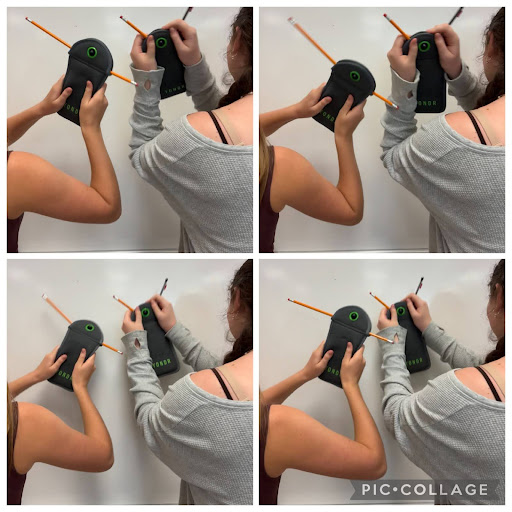
- And last but not least, there is the coveted “pencil method,” where students jam pencils, highlighters, or anything else they can get their hands on underneath the magnet, and bang the pouches against a hard surface to unlodge the magnet.
A survey was created and distributed to sophomore, junior and senior English classrooms at all levels to obtain a diverse data set of returning students from the school. The responses were varied.
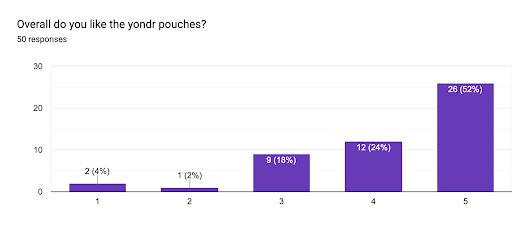
Do you like the Yondr pouches? (1: I love them to 5: I hate them)
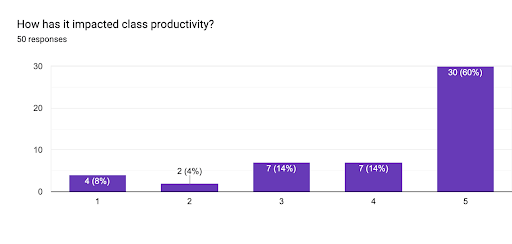
How has it impacted class productivity? (1: Significantly more productive to 5: not at all)
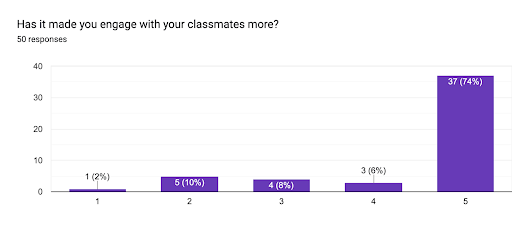
Has it made you engage with your classmates more? (1: Yes! To 5: Not at all)
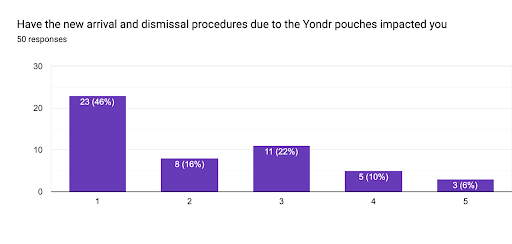
Have the new arrival and dismissal procedures due to Yondr pouches impacted you? (1: Yes, they have impacted me a lot to 5: No, not at all)
When asking for additional input, anonymous responses showed different opinions on the policies.
“I feel like Yondr pouches should be on a by-need basis. Like a punishment type thing where if your phone is seen x amount of times it gets yondered.”
“People have already found workarounds for them so nothing has really changed.”
“We used to be distracted by using our phones; now we’re distracted by trying to have our phones. [Since] they were taken away from us, [we] now want to use them more. People are still on their phones, whether we’re implementing the Yondr pouch or not.”
“I think they are a great way to keep kids focused in school.”
“The idea is great, but as [everyone knows], teens will just find a way around it if it’s concerning their phones.”
“The Yondr pouches are wasting valuable class time before and after school. They are wasting so much money that could have been used for countless other things.”
“I feel like instead of focusing on work, people focus on ways to get their phone out of the pouch, so either way, it’s not helping out at all. Also, the new arrival thing is so annoying.”
The Yondr policy has disrupted school norms and received both positive and negative feedback However, it is clear that the administration is doing their best to make a smooth transition and create a more positive and engaged learning environment for students. The goal is to create more streamlined processes as the year progresses for the betterment of the student body.
“The sounds of cracking Yondr magnets being slammed against walls booms throughout the school which adds character and or community; Yondr is always a good source of conversation, too,” Rau said.