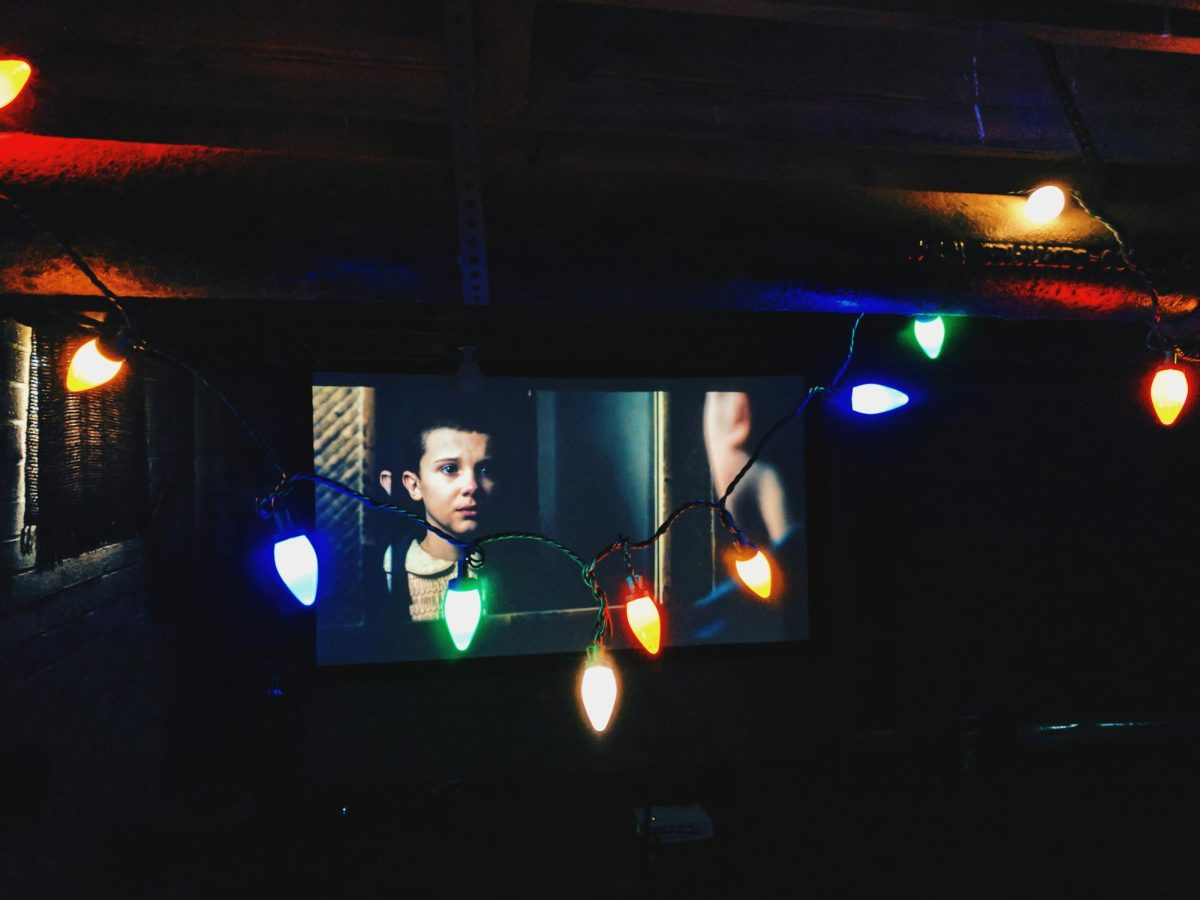
After a grueling three-and-a-half-year wait, “Stranger Things” has finally returned for its final season. The first four episodes of Season 5 Volume 1, as Netflix has dubbed it, dropped on Nov. 26, just in time to give fans something to binge over Thanksgiving break. And what a return it has been.
The Duffer Brothers, Matt and Ross, have been promising that this final season would bring the story full circle, back to the mystery that started it all: the vanishing of Will Byers. They were not lying. From the opening moments of “Chapter 1: The Crawl,” it is clear that this season is the most intense it has ever been.
Season five picks up roughly 18 months after the catastrophic events of season four’s finale, which saw Vecna (Jamie Campbell Bower) tear open massive rifts between Hawkins, Indiana, and the Upside Down. The town is now under military quarantine, and its residents are trapped behind checkpoints and armed soldiers while portals to another dimension quite literally scar the town. Hawkins has become a garrison state, with Lieutenant Colonel Sullivan’s (Sherman Augustus) forces occupying the town under the guise of protection. But as the characters quickly discover, the military presence is less about keeping residents safe and more about hunting down Eleven (Millie Bobby Brown), whom they blame for the dimensional breach.
If Season 1’s inciting incident was Will’s disappearance, Season 5 escalates that premise to even larger proportions. The second episode, provocatively titled “The Vanishing of…” (the full title withheld by Netflix because it constitutes a spoiler), opens with one of the most intense sequences.
Holly Wheeler, Nancy and Mike’s youngest sister, played by Nell Fisher, becomes the target of a coordinated Demogorgon attack on the Wheeler household. The Demogorgon uses gates from the Upside Down to travel through the Wheelers’ home and trap Holly. The sequence is extremely intense: Karen (Cara Buono), enjoying what should be a relaxing bubble bath, suddenly finds herself fighting for her daughter’s life with nothing but a broken wine bottle as a weapon. Her husband, Ted (Joe Chrest), perpetually oblivious throughout the entire series, gets his own rude awakening when he is mauled while trying to protect his family. The sequence ends with the abduction of Holly into the Upside Down, and Ted and Karen are severely injured in the hospital.
The first half of the season is largely powered by Holly’s kidnapping, along with the discovery that she is not the only child being taken. Where Will’s disappearance in Season 1 was more of a small-town mystery, Holly’s vanishing is on a much larger scale.
One of the season’s side plots involves Max Mayfield (Sadie Sink), who we last saw in a coma after barely surviving Vecna’s attack in Season 4. The question of where Max’s consciousness has been—whether she’s truly gone or trapped somewhere—finally gets an answer in Episode Three. As it turns out, Max has been living inside Vecna’s memories, cycling through different moments in his past. She saw his high school years, when he was just a lonely, strange teenager crushing on a young Joyce Byers. She experienced the exact moment he invaded her own mind back in Season 4 and is forced to relive her own trauma from his perspective. The cave where Max has been hiding is apparently the one place in Vecna’s mindscape that he cannot enter, as there is something stopping him. This raises more questions than it answers. Why cannot Vecna enter? What is it about that specific memory or location that repels him?
This side plot felt random to me, as it does not correlate much with the other characters. However, I am sure it will all come full circle in the next volume, and I am intrigued to see how it will connect to the bigger picture.
The fourth episode of Season 5, aptly titled “Sorcerer,” referring to Will’s Dungeons & Dragons class, was one of the most exciting finales I have ever watched. When confronted by another horde of Demogorgons at the makeshift sanctuary where Joyce, Mike, Lucas, Robin, and a few rescued children await, Will finally ceases running away from his link to Vecna and faces it.
In a scene that literally had me sitting forward on my couch, unable to look away from the screen, Will harnesses the Hive Mind. In a beautifully cinematic flashback sequence, Will remembers Castle Byers, his childhood fort, and his bond with Mike Wheeler and realizes that he does share some telekinetic abilities with Eleven. As the Demogorgons prepare to go in for the kill, Will’s eyes turn white as he uses his powers on every one of the Demogorgons with a vengeance akin to Vecna’s: bones snapped, bodies twisted, and the creatures thrown around like rag dolls. When it is over, he wipes a single drop of blood from his nose—Eleven’s signature move.
The Duffers have confirmed that they were always certain it would be Will who killed Vecna, and that decision fits perfectly with the story. Will was the one who got taken first. Will was the one who was controlled by the Mind Flayer. Will has had a connection to the Upside Down longer than anyone except Eleven. So, making him the “chosen one” sounds very full-circle. However, here is the question Episode Four leaves us with: Is Will harnessing the Upside Down’s power, or is he becoming another Vecna? That final shot with Will standing among the broken bodies of Demogorgons, blood trickling from his nose, is deliberately ambiguous. We have seen what happens when someone with powers and a connection to the Upside Down feels isolated and misunderstood. Henry Creel became Vecna. What’s to stop Will from following the same path?
I personally was incredibly shocked by this twist, as were most fans. It seems now that Will is somehow tethered to Vecna’s mind, which makes me wonder how he will be defeated without harming Will.
While Will discovers his abilities, Eleven faces her greatest vulnerability. The military has developed a sonic device that renders her powers completely useless—a high-frequency sound that causes her excruciating pain and strips away her abilities. This is the first time we have seen Eleven with a clear weakness. Along with this comes the revelation that the military has been studying her and finding ways to neutralize her. Dr. Kay (Linda Hamilton) is not just hunting Eleven out of misguided patriotism. She seems to have a personal agenda, as she states that she has been “looking for you for a very long time.”
The storyline in the Upside Down, where Hopper (David Harbour) and Eleven are trying to break into the military’s interdimensional base, occasionally drags with repetitive infiltration scenes, but it pays off with a major plot twist at the end of Episode Four. The person being held in the supposedly impenetrable vault is not Vecna, as everyone assumed. It’s Kali (Linnea Berthelsen), Eleven’s “sister” from the controversial Season 2 episode that everyone loves to hate. Kali’s return is either going to vindicate that disliked episode or compound its problems, depending on what the Duffers do with her. But her presence suggests that Dr. Brenner’s other experimental subjects will play a larger role in the endgame than anticipated. If Vecna is trying to create his own army of powered children, which seems to be his plan with the abducted kids, having Kali on Eleven’s side might level the playing field.
I thought it was great to bring Kali back because one episode in Season 2 felt very random.
One of Volume One’s greatest strengths is how it gives nearly every member of the cast a moment to shine. Steve Harrington (Joe Keery) gets to be both the protective big brother and the guy who suggests driving a car directly into the Upside Down to track a Demogorgon. The original core four—Dustin (Gaten Matarazzo), Lucas (Caleb McLaughlin), Will, and Mike (Finn Wolfhard)—have graduated from being protected kids in Season 1 to protectors themselves. If I had one complaint about the characters this season, I would note the change in Dustin’s character. This season, he is still grieving the death of Eddie (Joseph Quinn) from Season 4. I found him a bit annoying, to be frank, as he often brought the mood down and was not really connected to the other characters, but I do understand this is a realistic depiction of how one would act after their best friend died.
I think the true MVP of these episodes might be Priah Ferguson’s Erica Sinclair, who has evolved from “just Lucas’s annoying little sister.” Her scene in Episode Three, where she shows up at the Turnbow house with a benzo-laced pie to knock out an entire family and then pulls out a syringe when her ex-friend, Tina, refuses to eat it, is hilarious and also a little terrifying. “I told you to eat your damn pie!” might be the best line of the season so far.
Additionally, I loved the introduction of Derek Turnbow (Jake Connelly) as a bully who becomes an unlikely ally. I thought he was a great addition to the main group of characters.
Although I thoroughly enjoyed Volume One, one of the main critiques is its runtime: the four episodes clocking in at 55, 68, 74, and 87 minutes, respectively. That is nearly five hours of television, and while most of it is necessary, I think some sequences could have been shortened. Particularly, the subplot of Eleven and Hopper’s infiltration in the Upside Down felt a little redundant at times. I do not really mind the extended episodes, but I think that not every action sequence needs to be quite so long.
There is also the ongoing issue of plot armor. When the Demogorgon attacks the barn in Episode Four, we get a lengthy, chaotic sequence of characters in danger. But does anyone really believe that Joyce, Mike, Robin, or any other major character is actually going to die before the final episode? The show has trained us too well. Even Hopper’s fake-out moment in the Upside Down, where he gives what sounds like a goodbye speech to Eleven only to be perfectly fine when we return, feels a little like a repeat of Season 2 cliffhanger tactics. The Walking Dead lost 97% of its audience between its premiere and finale, partly because viewers stopped believing any stakes mattered. “Stranger Things” is not there yet, but the longer the Duffers protect their core cast from consequences, the harder it becomes to invest in the danger. Someone needs to die, and it needs to hurt, or the finale risks feeling hollow no matter how spectacular it looks. I also do not love the use of CGI this season, as it feels slightly fake and takes away from the authenticity.
What these episodes do exceptionally well is begin to answer the deeper questions that have accumulated over four seasons. Why was Will taken first? What exactly is the Upside Down? How are Vecna, the Mind Flayer, and the Demogorgons connected? We have not gotten all the answers yet—that is what Volumes Two and Three are for—but the Duffers are clearly building toward revelations they have been planning since the show’s start.
The discovery that Vecna is abducting children to essentially create his own Hawkins Lab, with himself as Dr. Brenner, is a really interesting way to tie everything together. The show has always been about cycles of abuse and trauma. Brenner experimented on children, turning them into weapons. Vecna, who was once Brenner’s most successful subject, is now doing the same thing with a new generation. Will, who was Vecna’s first victim, now has the power to break that cycle. It is excellent storytelling.
All in all, I have thoroughly enjoyed this season so far. I think it adds an entirely new feeling to the show as a whole, while still maintaining that nostalgic Season 1 vibe. After nine years, “Stranger Things” is finally beginning to end. If these first four episodes are any indication, the Duffer Brothers might actually end one of the greatest shows successfully. Either way, I will be counting down the days until Christmas, desperate to know what happens next. Volume 2 of “Stranger Things” Season 5 arrives on Netflix on December 25. The series finale drops on December 31, with a theatrical release in select theaters.
After finishing the season, I feel a mix of emotions.
Vecna’s plan becomes much clearer in the final episodes of Volume Two, as it is revealed that the abducted children are part of his attempt to recreate Hawkins Lab, using them as anchors to stabilize his control over the Upside Down. It is a parallel to Dr. Brenner’s experiments, and it reinforces the idea that Vecna is not just a monster, but a product of the same cycle of abuse the show has explored since Season 1. I thought this was really well done.
That being said, some of the issues from Volume One remain. The CGI-heavy sequences in the finale occasionally look artificial, and a few action scenes drag on longer than necessary. At times, the scale of the final battle can be overwhelming to the smaller character moments that made early seasons so compelling. However, these problems are relatively minor compared to how emotionally effective the finale is.
The season finale received many critiques from viewers and critics; however, I personally enjoyed it. I thought the final shots of Mike watching Holly and her friends play Dungeons & Dragons felt very full-circle, back to the main four in Season 1, where it all started. It felt symbolic, as Mike was essentially passing the torch to the new generation. In the end, Season 5 succeeds because it remembers what made “Stranger Things” work in the first place. It is not really about monsters or alternate dimensions, but about kids who were traumatized and grew up carrying that weight with them. After nearly a decade, “Stranger Things” finally closes the gate. And while saying goodbye is painful, it feels like the right time.