

Today’s America is dominated by technology. Technological advancements are constantly introduced by companies, which significantly impact not only daily living but also classrooms, including those at the school.
Assistant Principal Katlyn Bennett felt prepared and excited for the upcoming school year; however, one thing she did not anticipate was students’ fixation on and use of artificial intelligence (AI), a technology that can generate whatever the user asks and support students struggling with assignments.
AI, a “holy grail” of sorts, has been a solution to students’ academic woes as a tool that simulates human intelligence, with its usage and development increasing rapidly over the past couple of years.
To get results when using AI, all students need to do is give specific instructions. For example, students can direct AI to generate answers to a list of questions, write an essay, fabricate fake research sources for projects, and more.
With students’ attention spans and creativity already harmed by virtual learning, the idea of turning to AI, like ChatGPT, is alluring to them. However, at what point is the line drawn between using AI for occasional help on some things and having AI generate an entire essay? This question is often asked by administrators, as students can misuse AI, ultimately harming their learning experience and academic performance.
“It is disconcerting when we look at how many students are heavily dependent on artificial intelligence, particularly ChatGPT. While teachers can detect when students use AI tools, it can be tricky to pinpoint exactly what students need help with that are having them resort to AI. Many educators feel that students are relying on AI to understand concepts instead of asking them for help, which shows signs of academic struggle,” Bennett said.
Much of the student population at the school relies on AI for a variety of subjects, including English, science and math. ChatGPT is widely used in schools. A survey from Lumina noted that 46 percent of high school students use AI tools, and a study in 2024 from 74 Million claimed that about 60 to 70 percent of high schoolers admitted to using AI to cheat, statistics that have risen significantly since then. As the amount of usage increases, so do the concerns surrounding student use of AI.
Concerns about critical thinking skills and creativity are common among teachers throughout the building, including Bennett, who acknowledges the concerns regarding AI use on students.
“I haven’t heard too many parents’ concerns about students using AI, at least not this year. I could see some of the concerns being students not doing their own work, or becoming uncreative or lazy,” Bennett said. “I think we need to be careful about how much of our own thinking we’re outsourcing to AI. People are really creative and artistic, and our brains are amazing. To think that a computer could do the same thing that a human can do is sort of dangerous, and I think that it could make us lazy and uncreative if we overuse it.”
Freshman Maeve Gnomes echoes Bennett’s ideas. As a competitive Irish dancer, track athlete and devoted student, Gnomes does not have a lot of free time for homework. Spending eight hours a day at dance is not productive to her academic performance, something all busy students can sympathize with. However, utilizing some of the school’s allowed AI resources has allowed her to stay on top of her schoolwork and master the content extensively.
AI is constantly stretching the limits of its capabilities, benefiting from technological advances.
As AI grows, so does the number of beneficial ways it can be used. Gnomes typically use AI to think deeply about specific subjects. By doing so, her critical thinking skills and creative abilities are strengthened, skills that contribute to successful performances in the classroom.
“AI helps with understanding the concept of what you’re learning and allows you to dive deeper into the meaning of what topic you’re asking it to assist you with,” Gnomes said.
Similarly, Rachel Hogan, a freshman at the school, is in the same boat as Gnomes. Hogan is an active member of the school’s field hockey team and spends most of her week in practices or at games. Aiming to eventually participate in the International Baccalaureate (IB) Program in later years, she heavily focuses on her schoolwork and academic standing. It is hard to complete homework, assignments and study for exams with her demanding athletic schedule; however this is where AI comes in handy.
The main way Hogan uses AI is to save time but still understand the content effectively, a struggle that directly impacts her schoolwork and academic performance. With AI, the summation of core content saves valuable time and adequately prepares Hogan for upcoming exams.
“It helps summarize some of my work so I don’t have to read everything when I’m in a time crunch,” Hogan said. “It also comes in handy when I ask it for help with summarizing texts, producing outlines to study, and creating study guides for tests.”
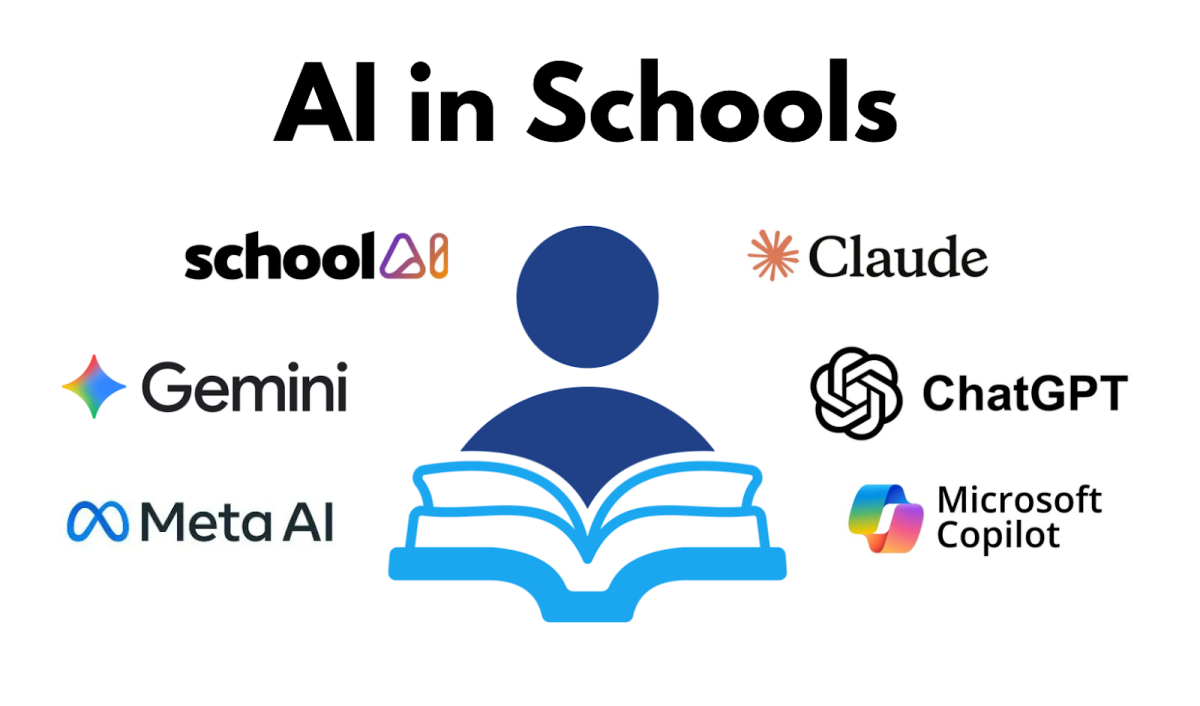
For some students at the school, the AI sources they are allowed to use may be unclear. While APS declares the use of ChatGPT is not permitted, other resources, including SchoolAI, Microsoft Copilot, Google Gemini and Notebook LM are accessible as laid out in the “Year of AI Empowered Learning 2025-2026” handbook. The handbook is composed by a collection of educators in Arlington, and all APS schools must adhere to its standards. It includes ethical concerns involving AI, how parents can be involved and the responsibilities of teachers and students when it comes to using AI in an academic setting.
Teachers must review the safe and ethical use of AI with students, clearly communicate the level of acceptable AI use for assignments or projects to both students and families, and model proper citations of AI use, according to the handbook. Students are required to communicate openly and honestly with teachers about how AI is used, follow the acceptable use guidelines for each assignment or project and demonstrate proper citation of AI use.
It is evident that AI is constantly changing the world. Whether in the classroom, the workforce or other sectors, someone will always depend on it. As technological advances continue to be made, students, teachers and families must have a clear consensus on the appropriate ways to use AI.
Not only in order to maintain original work in and outside of the classroom, but also to allow our brains to be challenged and to think critically. By simply having AI, such as ChatGPT, generate an assignment response or an essay, students could potentially be harming their academic standing and their future. How can this generation develop future innovations if they cast away the inner workings of their mind in turn for a technological device? How can they grow, not only as students, but as humans? Some feel there have to be boundaries placed alongside the benefits of using AI. Students, teachers, and families must continue to work together to maintain them for the benefit of the next generation.
When contemplating how schools can effectively balance AI use and ensure cohesion with students, Bennett has a few ideas.
“I think using school approved resources makes sure that if teachers want students to use it, they’re being really specific about how and what the boundaries are for using AI.” Bennett said. “I think students doing a lot of their work in class will help also, and just being really clear that you know when students are submitting papers or assignments that they can’t use AI.”













Patricia • Nov 18, 2025 at 12:07 PM
THIS IS GREAT